Wednesday, September 18, 2013

From Chris Hedges

ELIZABETH, N.J.—JaQuan LaPierre, 22, was riding a bicycle down a sidewalk Sept. 5 when he noticed a squad car pulling up beside him. It was 8:30 on a hot Thursday night at the intersection of Bond Street and Jackson Avenue here in Elizabeth, N.J. LaPierre had 10 glass vials of crack cocaine—probably what the cops were hoping to find—and he hastily swallowed them. He halted and faced the two officers who emerged from the cruiser.
“We are tired of you niggers,” he remembers one of the officers saying. “We’re tired of all this shooting and robberies and violence. And we are going to make you an example.”
He was thrown spread-eagle onto the patrol car.
“What I bein’ arrested for?” LaPierre asked.
A small crowd gathered.
“Why you harassin’ him?” someone asked the cops. “He ain’t resisting. Why you doin’ this?”
One of the officers went though LaPierre’s pockets and took his keys and $246 in cash. LaPierre kept asking why he was being arrested. He was pepper-sprayed in the face. One officer threw him onto the street, and, while he was handcuffed, the two cops kicked and beat him.
“What you beatin’ my nephew for?” his uncle, Antoine, said to the cops.
Click here to see a video that an onlooker recorded as members of the Elizabeth, N.J., Police Department assaulted JaQuan LaPierre early this month.
“It was so hot on my face,” LaPierre said of the pepper spray when we met a few days ago. “I was gasping for air.”
More police arrived. They pushed back onlookers, including the uncle. LaPierre was gagging and choking. He was dragged across the asphalt. By the time the beating was over, blood was coming out of his mouth. He was unconscious. The assault was caught on a camera, even though when the police saw they were being recorded they pointed a flashlight beam into the lens.
The only visible crimes LaPierre had committed was riding a bicycle on a sidewalk and failing to wear a safety helmet.
Police abuse is routine in Elizabeth, as it is in poor urban areas across the country. This incident did not make news. But it illustrated that if you are a poor person of color in the United States you know what most us are about to find out—we have no civil liberties left. Police, who arrest some 13 million people a year, 1.6 million on drug charges—half of those for marijuana counts—carry out random searches and sweeps with no probable cause. They take DNA samples from many of those they arrest, even some eventually found to be innocent, to build a nationwide database. They confiscate cash, cars, homes and other possessions based on allegations of illegal drug activity and direct the proceeds into police budgets. And in the last three decades the United States has constructed the world’s largest prison system, populated with 2.2 million inmates.
As in most police states, cops serve as judge and jury on city streets—“a long step down the totalitarian path,” in the words that U.S. Supreme Court Justice William O. Douglas wrote in 1968 when he decried expanding police powers. And police departments are bolstered by an internal surveillance and security apparatus that has eradicated privacy and dwarfed the intrusion into personal lives by police states of the past, including East Germany.
Under a series of Supreme Court rulings we have lost the rights to protect ourselves from random searches, home invasions, warrantless wiretapping and eavesdropping and physical abuse. Police units in poor neighborhoods function as armed gangs. The pressure to meet departmental arrest quotas—the prerequisite for lavish federal aid in the “war on drugs”—results in police routinely seizing people at will and charging them with a laundry list of crimes, often without just cause. Because many of these crimes carry long mandatory sentences it is easy to intimidate defendants into “pleading out” on lesser offenses. The police and the defendants know that the collapsed court system, in which the poor get only a few minutes with a public attorney, means there is little chance the abused can challenge the system. And there is also a large pool of willing informants who, to reduce their own sentences, will tell a court anything demanded of them by the police.
The tyranny of law enforcement in poor communities is a window into our emerging police state. These thuggish tactics are now being used against activists and dissidents. And as the nation unravels, as social unrest spreads, the naked face of police repression will become commonplace. Totalitarian systems always seek license to engage in this kind of behavior by first targeting a demonized minority. Such systems demand that the police, to combat the “lawlessness” of the demonized minority, be, in essence, emancipated from the constraints of the law. The unrestricted and arbitrary subjugation of one despised group, stripped of equality before the law, conditions the police to employ these tactics against the wider society. “Laws that are not equal for all revert to rights and privileges, something contradictory to the very nature of nation-states,” Hannah Arendt wrote in “The Origins of Totalitarianism.” “The clearer the proof of their inability to treat stateless people as legal persons and the greater the extension of arbitrary rule by police decree, the more difficult it is for states to resist the temptation to deprive all citizens of legal status and rule them with an omnipotent police.” 
Once you are branded a felon, as Michelle Alexander points out in her book “The New Jim Crow,” you are “barred from public housing by law, discriminated against by private landlords, ineligible for food stamps, forced to ‘check the box’ indicating a felony conviction on employment applications for nearly every job, and denied licenses for a wide range of professions.” And this is for people who might have had only a small quantity of drugs, perhaps a few ounces of marijuana. There are 6 million people who because of felony convictions are permanently shut out from mainstream society. They are second-class citizens, outcasts. The war on drugs—aided by hundreds of millions of federal dollars along with federal donations of high-velocity weapons, helicopters, command vehicles and SWAT team military training—has become the template for future social control. Poor people of color know the truth. They were the first victims. The rest of us are about to find it out. 
LaPierre was taken unconscious to a hospital. He woke up with both hands handcuffed to a gurney. He was vomiting blood. Two of the glass vials, each worth $10 on the street, came up with his vomit. The police, ecstatic, had the drugs they had hoped to find when they stopped him.
“It’s over for you,” he heard an officer say. “You’re goin’ down.”
“You spittin’ at an officer?” one of the cops said laughingly. “Your boys are not here to protect you now, are they?”
  LaPierre could not see. He heard the officers discussing the charges and making sure the official story was coherent. One officer, inexplicably, yanked out some of LaPierre’s hair, braided in cornrows, and stuffed the hair into the handcuffed man’s pants “on my private parts.”
“Trying to disarm an officer,” he heard one say as they tallied the charges. “Possession. Resisting arrest. Starting a riot.” By the time he was transferred out of the hospital five days later there would be nine charges and a $35,000 bail.
“During the last couple of days the police have been telling people in the neighborhood that if they go to court to testify about the beating of JaQuan they will be arrested and go to jail too,” Myrtice Bell, LaPierre’s grandmother, told me.
LaPierre, who was on probation for allegedly resisting arrest during another routine stop, a charge he says was false, and who has a pending charge of being in a vehicle with other men in which an illegal weapon was found by police, appears destined to be swallowed into the vast prison system. He will become, if he is railroaded into prison, one more person among the more than 2 million behind bars in the U.S. His experience, and the experience of others in poverty-stricken communities, should terrify us. Our failure to defend the rights of the poor in the name of law and order, our demonization of young black men, our acceptance that they can be stripped of the power to protect themselves from police abuse or find equality before the law, mean that their fate will soon become ours.

Monday, September 16, 2013

They are ALL thieves (of their pay and our liberty) and stupid, too

9/16/2013
Florida Police Jail Man For Protesting Red Light Cameras
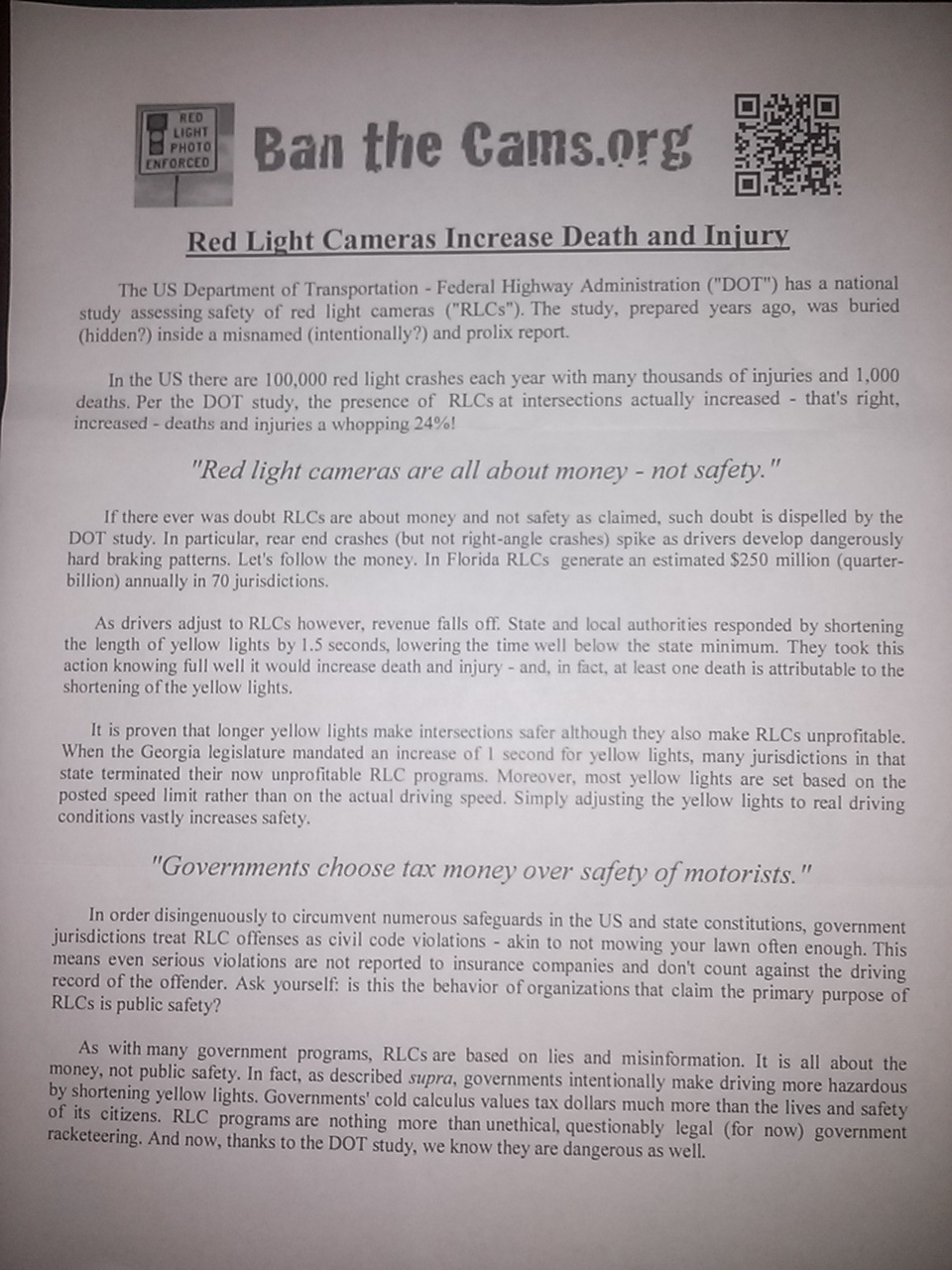
Man arrested for petitioning the Apopka, Florida city government to end red light cameras.Mark E. SchmidterPolice in Apopka, Florida arrested a man on Saturday morning for distributing a petition that would put the issue of ending red light camera use to a public vote. Mark E. Schmidter, a 66-year-old commercial roofing contractor, stood on the side of the road waiting for the light to turn red at the corner of East Main Street and South Park Avenue. Once traffic came to a stop, he would walk in between cars and distribute a double-sided sheet of paper. One side had a petition form that residents could fill out and a message urging participation in Wednesday's city council meeting. The other side provided information on why cameras should not be used (view flyer).

"Red light cameras are all about money -- not safety," the flyer said in large type. "Governments choose tax money over safety of motorists."

Officer Robert Campbell watched what was going on and used the public address system on his squad car to order Schmidter to stop. Schmidter says he was not able to understand what was said on the loudspeaker. Officer Campbell described the scene in his arrest report.

"As I was approaching him, I read 'BAN CAMS' on the sign he was wearing," Officer Campbell wrote. "He was holding a large stack of papers... I asked him if he had a permit to protest the red light cameras, and he said no."

At this point, Officer Campbell asked for Schmidter's identification. Since he was not driving, the man explained he was not carrying any. The officer then asked for his name and date of birth. Schmidter declined to do so unless the officer could show him what law he had violated. Officer Campbell said he did not have to do that. After asking one more time he grabbed Schmidter's wrist, handcuffed him, and placed him under arrest.

During the commotion, a man came out of Chuck's Wagon restaurant and identified himself as a former county judge to one of the other officers on the scene. He recognized Schmidter from a previous incident where Schmidter was jailed for handing out flyers on the courthouse steps outside of a designated free speech zone.

"That's the last person you need to mess with," the judge warned.

Schmidter's previous flyer case made it to the state's second highest court which in December found unconstitutional one of the county court administrative orders under which Schmidter had been arrested, but it upheld the other. The state Supreme Court declined to intervene, and Schmidter is considering an appeal to the US Supreme Court. On Saturday, judges were not the only supporters of Schmidter, according to the police report.

"Other protestors across the street began heckling me for making a bad arrest," Officer Campbell wrote. "This information was added to show the demeanor of the group the arrested male was with."

Schmidter says most of the motorists he spoke with that morning supported what he and his group were doing.

"Eighty percent thought we were sent from heaven," Schmidter told TheNewspaper in an interview. "They're so frustrated. The other twenty percent weren't interested."

Schmidter was charged with obstructing an officer without violence, a misdemeanor. He was also given a $65 ticket for a "pedestrian violation" and held for nearly twelve hours before being released on a $500 bond. Schmidter plans to fight the charges in court before a jury of his peers, saying his First Amendment rights were being trampled.

"It's selective enforcement, and that alone is unconstitutional," Schmidter said. "The homeless are in the street asking for money, and firefighters do it, too. We don't raise money, we let people know about the red light cameras."

Only 500 valid signatures are required to force a referendum on the use of red light cameras onto the ballot in Apopka. Out of thirty such votes around the country, cameras have lost ninety percent of the time (view list).

Friday, September 13, 2013

Worst yet


The Enforcement Caste's War on Women

EmailPrintFacebookTwitterShare
Under what circumstances, if any, is it appropriate for two large men to throw a small woman face-down into a paved street, shattering her face? Is such an act justified because the woman is drunk and unpleasant? Does the moral nature of the assault change because of the way the assailants are dressed?
If the woman is suspected of a non-violent crime, and wasn’t cooperative when police arrested her, are we permitted to conclude that she “had it coming”? Are police officers entitled to dispense summary punishment, or retaliatory violence, against uncooperative suspects?
On August 10, Christina West of Tallahassee, Florida – who was under the influence of alcohol and painkillers — drove her car off a road and into a house. Officers Christopher Ormerod and Matthew Schmidt arrived to investigate the crash. After West performed poorly on several sobriety tests, she was handcuffed and placed in a police car. The 44-year-old woman was so small that she managed to slip out of the cuffs, and when the officers attempted to shackle her again she refused to cooperate.
This led to an incident that – after being fed through the Regime’s euphemism-generation filter — was described in the media as a “struggle,” rather than an act of gang violence.
As recounted in Ormerod’s official report, “West aggressively resisted by kicking her leg behind her and striking Officer Schmidt in the leg.” That action was violent, but resistance, by strict definition, cannot be “aggressive.”
Ormerod and West then “lifted West off the car so that she could be laid on the ground to prevent her kicking.” While she was being hoisted into the air, West fired a desperate kick behind her that, according to Ormerod, hit him in the genitals.
Since he is a police officer, we can assume that the target was quite small, which means that West’s uncanny aim belied her intoxicated condition. Ormerod explains that he and Schmidt then “pulled” West “to the ground so that she was laying [sic] on her stomach,” an action that somehow resulted in the woman suffering severe contusions and broken bones in her face.
Ormerod’s austere description doesn’t do justice to the actual event, as captured in the dashcam video. The officer can be heard snarling: “Don’t you f***ing touch me!” before slamming West’s face into the side of a police car, and then onto the pavement.
In his daintily-worded report, the officer carefully omitted mention of that outburst, which demonstrated that by face-planting West he was engaged in retaliation or summary punishment, rather than an attempt to control a suspect. He described the victim’s reaction to the assault as “screaming in rage and violently grasping with her hands at me” in what he described as an attempt “to grab for my genital area” – without mentioning that this happenedafter he and Schmidt had gang-tackled the woman and slammed her face into the concrete.
When West complained about the injury to her face, her uniformed assailant dismissively
replied: “You’re fine.”
A total of six officers eventually arrived to deal with the bloodied 5 foot six-inch, 130-pound woman. An examination at a local hospital revealed that West – far from being “fine” — had a broken orbital bone around her right eye.
Despite the fact that West’s face was wrecked, and her assailants were unscathed, the victim was charged with “battery on a law enforcement officer” and “aggravated assault on an officer.” Those charges were dropped, but the Tallahassee PD insists that tag-team face-planting of the partially handcuffed woman was “appropriate.”
It’s worth noting that Ormerod was previously cleared by the department after using a Taser to punish a teenager who had stepped in front of the officer’s patrol vehicle. When the officer yelled at the 15-year-old to be more careful, the teenager fled into his home. Rather than leaving well enough alone, Ormerod – no doubt out of zeal for the youngster’s safety – pursued the teenager into the house, tasered him, and then arrested him for resisting arrest.
This peculiar form of solicitude for citizen “safety” appears to be commonplace within Florida’s law enforcement caste. A similar display of concern by Florida Trooper Dan Cole left a 19-year-old woman in a persistent vegetative state.
Danielle Maudsley was arrested in September 2011 after fleeing from the scene of two accidents. Cole handcuffed Maudsley and took her to an FHP station in Pinellas Park. While the trooper filled out some paperwork, Maudsley – who was handcuffed but not secured – dashed out of the building. Cole gave pursuit for as long as his level of conditioning permitted, which apparently was no longer than two or three seconds. Despite the fact that he was within tackling distance of Maudsley, Cole drew his Taser and shot her in the back.
The Taser strike felled the 19-year-old woman, causing her to spin one hundred eighty degrees,  then fall backwards and hit her head on the concrete sidewalk. A dashcam video captured the entire incident, including the percussive, brittle sound of Maudsley’s head colliding with concrete.
“I can’t get up,” Maudsley gasped – the last words she will ever speak. She immediately lapsed into a coma. The injury left her brain-dead, as insensible as the tax-fattened clod who left her in that condition.
During the official inquiry, Cole insisted that it was necessary to use a Taser because “she was already outrunning me” and had to be stopped before she could dash into traffic – where, presumably, she could suffer an injury that might leave her brain-dead. This might have been prevented had the officer – who outweighed the slender girl by the better part of two hundred pounds — been willing to break a sweat.
“Tell me that’s not excessive force,” protested Cheryl Maudsley, the victim’s mother. “I’m not saying she was an angel, but she didn’t deserve that. He couldn’t reach out and grab her? He was an arm’s length away.”
Going “hands-on,” however, posed unacceptable risks, Cole protested during an official inquiry by the Florida Department of Law Enforcement.
“I [couldn't] just jump on her,” Cole maintained. “I’m three times her weight. If we go down, one or both of us is going to get hurt. The Taser is the intermediate weapon of choice.”Although routinely described as a “non-lethal” alternative to firearms, the Taser is regarded as a deadly weapon when it is seized by a criminal suspect and used against a police officer. Assuming that it is properly described as an “intermediate” option in the use-of-force continuum, Cole’s decision to employ it against a tiny, handcuffed, non-violent misdemeanor suspect is an unmistakable violation of the guidelines contained in the Florida Highway Patrol’s policy manual.
Use of a Taser (referred to as a Conducted Electrical Weapon, or CEW) by a trooper, the manual states, is appropriate only in dealing with a suspect who “(a) Has the apparent ability to physically threaten the [officer] or others; or, (b) Is preparing or attempting to flee or escape. (NOTE: Fleeing cannot be the sole reason for deployment of the CEW).” (Emphasis in the original.)
The manual also dictates that “Unless exigent circumstances exist, members shall not use the device in the following situations: (a) In a punitive or coercive manner;(b) On a handcuffed or secured prisoner.”
While Maudsley was obviously not “secured,” she was handcuffed. Cole’s laziness or lack of conditioning did not constitute an “exigent” circumstance. His Taser use was punitive, not defensive. Despite the fatal consequences to a non-violent offender who posed no threat to anybody, Cole – an amalgam of arrogance and adipose tissue — defiantly told the inquiry that he would do exactly the same thing in the future under the same circumstances. After reviewing the incident, both the Florida Highway Patrol and the Florida State Department of Law Enforcement concurred with Cole, ruling that his actions – though a violation of established guidelines — were “justified,” as they almost always are.
Despite the fact that she suffered terribly at the hands of Officers Ormerod and Schmidt, Christina West was spared a life-ending injury of the kind inflicted on Danielle Maudsley – something that could have happened very easily when her unprotected head was driven into the pavement by two large males. Although the injury to West’s right eye was considerable, she’s still able to see.
Monique Hernandez of Beaumont, California wasn’t nearly as fortunate: As a result of her encounter with Police Officer Enoch Clark, will never see her ten-year-old daughter again.
On February 21, 2012, Clark conducted a traffic stop involving Hernandez after receiving a call about a domestic dispute involving two of her relatives. According to witnesses, Hernandez’s sister got into a fight with her boyfriend during a child custody exchange. When the boyfriend attacked the young woman, Hernandez intervened to protect her sister, then fled with the woman and her 2-year-old daughter.
After Officer Clark arrived, he demanded that Hernandez undergo a sobriety test – then claimed that the Breathalyzer unit had malfunctioned. When Hernandez asked about the test results, Clark ordered her to shut up, then he slammed her head against the hood of his car. After yanking one of the uncooperative victim’s arms behind her back, the officer pulled out a “non-lethal” JPX device – a weapon that uses a gunpowder charge to fire a stream of pepper spray at roughly 400 miles an hour – and fired it at her head.The JPX weapon is designed for use at a distance of 6 to 15 feet, and training presentations depict it being used against armed targets. Promotional literature for the JPX weapon – which isn’t categorized as a firearm, because it doesn’t fire a projectile – boasts of “devastating stopping power.”
The payload of weaponized OC spray is propelled over the prescribed distance at less than three one-hundredths of a second, making it “too fast to avoid…. The effect is immediate; there is no chance to resist.”
Clark’s attorney insists that the officer’s attack was justified in order “to gain compliance and in defense of his person.” The JPX is not designed to induce “compliance,” but rather to incapacitate a targeted person at a distance. Clark – who was armed and wearing body armor — fired it into Hernandez’s temple from less than a foot away, blowing apart her right eye and leaving the left with severe, irreparable damage.
Anyone who had undergone rudimentary training with the JPX would understand that the weapon should not be fired directly into the head or face of a non-violent suspect. Clark’s actions demonstrated that his intention was not to gain “compliance,” but rather to inflict summary street punishment for “contempt of cop.”
Hernandez was taken to the hospital and never charged with an offense. Following an investigation by the county Sherriff’s office, a grand jury indicted Clark on four felony charges: Assault under color of authority, assault with a less lethal weapon, use of force causing severe bodily injury, and assault with force likely to cause severe bodily injury.
Clark, who was chairman of the local police union, was initially placed on administrative leave, and then quietly fired by the department. With the help of the most tenacious defense attorneys the police union can afford, Clark has filed a series of dilatory motions and has yet to stand trial.
Neither the presiding judge nor the DA’s office has displayed an abundance of zeal to see Clark prosecuted for a sadistic crime of violence against an innocent woman. But this is to be expected. Any time a woman is left disfigured, disabled, or dead as a result of state-authorized violence, the official view is that the victim must have done something to deserve what she received.

Friday, September 6, 2013

The "chief" position usually goes to the stupidest

Montana Police Dog Attacks Man Working Late At Restaurant . . . Police Chief Declines To Apologize And Says Dog “Did What He Was Supposed To Do”

Darren RaneySome jurisdictions have curtailed or even eliminated K-9 teams due to liability — reducing the majority of dogs to drug and bomb sniffing units. That is clearly not the case in Livingston, Montana. Mark Demaline, who cooks at the Park Place Tavern, was attacked late at night in his workplace when police found a door unlocked after hours and sent in a police dog named Bobi. What is most astonishing is not just the lack of an apology by police but the insistence of Chief of Police Darren Raney (left) that the dog “did what he was supposed to do.”

After the restaurant closed, Demaline did what he often did after work. He went next door to the Livingston Bar and Grille for a drink and then returned around 2 am to retrieve his laptop to go home. He made himself a quick salad for a late night snack and was heading to the door when he ran into Bobi. At first, he said “Hey, puppy” and tried to greet it. He says the dog attacked and lunged for his thigh. When he tried to grab Bobi’s collar, the dog went for his wrists. The dog bit him deeply in the thigh and brought him to the floor as the officer yelled for him to put his hands above his head — a difficult proposition with a dog clamped on your thigh.
The police forced Demaline to his feet painfully and pushed him out the restaurant in handcuffs. Then left him in handcuffs as they called the owner to confirm that he worked there. He was then taken to the hospital for the deep bites and a laceration on his back from when he fell.
Raney refused to apologized and stated “It’s acceptable for the dog to confront anybody in the business at that hour, . . . When the dog finds somebody in the building, he’s going to secure him, and that’s what happened . . .He did what he was supposed to do.” The Chief could not be stating a better case for a lawsuit. It is hardly unheard of for a person to be working late at a bar or restaurant, particularly with a bar just closing next door. While the police say that they called into the business, sending in a dog off leash is an extreme measure. While these dogs are trained to immobilize a person, there have been many lawsuits showing that many trained animals suddenly attack.
In the absence of an apology, perhaps Demaline will find some solace in a damages award. It is clear that this is a police department badly in need of some legal corrective action in my view. It is hard to believe that this tiny town has such a crime wave as to need this type of extreme enforcement measure. However, the town may now have to face the costs of excessive police action if Demaline sues, as he should, for this severe injury. To paraphrase the Chief, it is necessary for Demaline’s lawyer “to do what he is supposed to do.”
In another recent case out of Utah, a woman says that officers allowed a dog to attack her as she was asleep in front of a high school. She had previously had an encounter with a taxi driver who had refused to take her bike. She was awakened by the dog biting her leg. To make matters worse, the dispatcher praised the K-9 team saying “‘you two rock,’ ‘Wish we had instant photos in here!,’ ‘Severe trauma to the leg?,’ ‘Awesome extra treat for Vortex and you deserve a Slurpee!’”
Source: Livingston Enterprise
Kudos: Michael Blott

Saturday, August 31, 2013

From, guess who, William Grigg. Please donate.

Friday, August 30, 2013

From the Files of the Nineveh PD


Life was uncomplicated for emissaries of the Assyrian Empire. They weren’t burdened by conscience, or hindered by the need to make moral distinctions. Their role was to extract tribute for the king in Nineveh, destroy all potential resistance to his rule, and maintain order. To that end they dispensed aggressive violence without pretense or pity, and didn’t flinch from targeting women – including expectant mothers. 
At some point within the last decade or so, American police adopted a modified version of the Assyrian model of law enforcement. This helps to explain why it is now considered permissible for a police officer to assault an uncooperative but non-violent pregnant woman. 
Rochester, New York Police Officer Lucas Krull was recently captured on video assaulting a 21-year-old expectant mother named Brenda Hardaway, who had allegedly interfered with the arrest of her 16-year-old brother, Romengeno.
Police claim that they had arrived at the house to investigate a “disturbance” involving several people in the neighborhood. By the time they arrived, the fight – assuming that one had taken place – had dissipated. Rather than making sure nobody was hurt and then leaving, the police claimed that “tumultuous behavior” justified their involvement.
That “behavior” consisted of 16-year-old Romengeno calmly asserting his rights by refusing to speak to a police officer and denying him consent to come onto his property. The government-employed gangster replied by snarling that the young man was a “smartass” and placing his hands violently on the teenager. That provoked his sister to come to his defense. Krull claims that Brenda grabbed a can of pepper spray and ordered the police to leave. 
That’s when Krull escalated the incident by assaulting Brenda. As Krull threw her up against a vehicle, Brenda cried out, “Get off of me, you’re going to kill my baby” just seconds before the officer punched the woman in the back of the head and hurled her face-first to the ground. In the video, the victim is heard moaning, “My baby, oh my baby” as the officer continues his assault, kneeing her in the back and forcing her to put weight on her stomach.
Rochester PD Chief James Sheppard defended the actions of his trained 
simian, praising him for using “tremendous restraint.” He blamed Miss Hardaway for the assault she suffered, and described the blow to the back of her head as a “distractionary” strike. “When we receive resistance from an individual, we may strike you in a way that changes your channel, so to speak,” the chief smugly explained. “In a way that changes your resistance.” 
And when this tactic fails to subdue a pregnant woman, the Assyrian mercenaries under Sheppard’s supervision feel entitled to throw her face-down onto a sidewalk.
Romengeno was charged with two counts of disorderly conduct and a single count of resisting arrest. Miss Hardaway was booked on several charges, including felonious assault on a law enforcement officer. 
It’s worth remembering that all of this was supposedly justified because the police were dealing with “tumultuous behavior” – that is, the impermissible offense called “contempt of cop.”
This is not the first occasion on which a Rochester Police Officer has inflicted gratuitous violence on a pregnant woman. In an earlier incident, a young pregnant girl was kneed in the stomach by one of three Rochester Police Officers who were restraining her during an arrest. The assailant had just been informed that the victim was an expectant mother – which apparently prompted him to target her for a blow to the abdomen. 
A pregnant mother and an elderly woman were collateral victims in yet another episode involving “tumultuous” behavior. In April of last year, three Rochester cops swarmed and beat an innocent 25-year-old man named Jose Lugo, who was hospitalized after being subjected to “distractionary strikes.” 
Lugo was walking on a street near the home where he had lived for several years when a Rochester police cruiser suddenly screeched to a halt next to him and decanted three officers – Kevin Flanagan, Joel Hasper, and Richard Doran – who seized the bemused young man and started to drag him away.
When Lugo asked why he was being abducted, the assailants threw him to the ground, kicked him, beat him, and tasered him at least three times.  The thugscrum expanded to fifteen as reinforcements arrived. Lugo’s aunt, Annette Velzquez, pleaded with the officers to stop beating her nephew, then informed themthat she was going to call Chief Sheppard, whom she had met while working in the local school district. Backup officer Benjamin Mitchell responded by shoving Velazquez, stealing her cell phone, pepper-spraying her, and arresting her. A pregnant mother and an elderly mother were also attacked by Mitchell or his comrades. 
While Lugo was in the hospital – where he was kept under armed guard by the gang that had inflicted his injuries -- he was charged with “assaulting” the armed bullies who had put him there. 

This follows long-established procedure: Any time a police officer goes “hands-on” with an innocent victim, the victim is charged with a crime to consecrate the laying-on of hands as a ministration of official justice, rather than an act of criminal violence. Lugo had to endure six months of expensive and unnecessary legal harassment before being acquitted of the spurious charges.
Raven Dozier of DeKalb County, Georgia was likewise charged with a crime after she and her then-unborn child were assaulted by a police officer. Dozier, who was nine months pregnant, was present when police arrived to deal with a domestic dispute between her brother and his girlfriend. She had actually been urging her brother to cooperate with the officers – until the point at which they threw him to the ground, attacked him with “distractionary strikes,” and tasered him.
“He’s on the ground!” Dozier cried in horror. “You don’t need to do that!”
Displaying the refinement that typifies those who follow his loathsome profession, one of the officers snarled at Dozier to “Shut the f**k up!” To punctuate that directive, Officer Jerad Wheeler strode up to the sobbing and horrified woman and kicked her in the stomach with sufficient force to open a door. 
Dozier’s brother was dragged out of the house, and several police conferred on the front porch. After one of them pointed out that they had a problem because Wheeler had “kicked a pregnant woman,” another observed that they had to “charge her with something.”
Raven Dozier's injuries.
A few minutes later, Dozier – who was recovering from the assault – was approached by the on-scene supervisor, who in a voice of affected concern said that the officers needed to take her photograph. He instructed her to put on her shoes and follow him outside. 

The instant Dozier crossed the threshold of her home, Dozier was arrested for “obstruction” and taken away in handcuffs to the DeKalb County Jail. The intake officer, who possessed some residual decency, refused to book the victim. He demanded that Dozier be taken to the hospital, where she passed a small issue of blood and amniotic fluid.
Her son, Levii, was born by way of an emergency C-section a few weeks later. Doctors informed her that the kick to her abdomen had been delivered with sufficient force to cause the child to defecate in utero – which means that he had the sh*t kicked out of him by a police officer before he was born. 


Wheeler is a police officer, which means he is trained to lie, given social permission to lie, and does so without hesitation. In his official report of the incident, Wheeler falsely claimed that he was dealing with an “aggressive” woman and that he used “a front push kick to the abdomen, as [I] was taught to do at the academy” – once again, as a “distractionary” strike. It was only after he arrested this “aggressive” woman that he supposedly noticed her condition. His potentially fatal act of criminal violence was ratified by his superiors, who blithely stated that it was “within policy.”

Police in Ocean City, Maryland also “acted appropriately” when they tackled and assaulted 24-year-old Dalima Ekundayo Ibironke Palmer, who was part of a group being investigated for – what else? – “tumultuous” behavior at a local beach. Palmer was nine months pregnant, a fact that was obvious to horrified onlookers who pleaded with the police as they wrestled with the woman. Shortly after being abducted, Palmer underwent an emergency c-section – but not before being hit with four charges, including assault on a police officer.
In at least two separate cases, police have attacked pregnant women who went to them seeking help.

Jacksonville, Florida resident Melanie Williams, who was seven months pregnant, went into premature labor and called 911. Bleeding and dizzy, Williams decided not to wait for help and drove herself to the hospital, running a red light en route.


When she was pulled over, Williams frantically told the officers that she was losing her baby, sped off to the hospital, and dashed inside. However, the officers pursued her into the building, tackled her, and handcuffed her as she screamed, “I’m pregnant – someone help me, I’m bleeding!” One of the officers thoughtfully responded to that plea by putting a boot on her neck, and them stomping on her back, before she was dragged from the emergency room and put into a squad car. Thankfully, the child survived the vicious attack on her mother.

Valreca Redden was tasered by police in Dayton, Ohio when she visited a suburban police station to request that her one-year-old son be taken into protective custody. After speaking briefly with the police, she changed her mind and said, “I’m leaving.” Despite the fact that Redden wasn’t suspected of a crime, she was told that she wasn’t free to leave.

Officer Michael Wilmer grabbed the thirteen-month-old child with one arm and used the other to shove the mother to the floor. A second officer materialized and attempted to handcuff the screaming woman. When she resisted, he applied a taser to the back of her neck. Redden was charged with “resisting and obstructing”; as she was being checked into jail, one of the officers discovered that she was visibly pregnant.


Seattle resident Malaika Brooks was seven months pregnant when she was stopped for speeding while driving her 11-year-old son to school. When presented with the extortion note, Mrs. Brooks refused to sign it, assuming that by doing so she would be admitting guilt. The officer then attempted to arrest her for violating a “law” that defines such a refusal as a “crime.” Not surprisingly, Mrs. Brooks didn’t allow herself to be kidnaped without putting up as much resistance as possible.

Three officers were dispatched to put down this intolerable act of defiance. Officer Juan Ornelas twisted Brooks’ arm behind her back while Officer Donald Jones applied a taser to her left thigh, then her left arm, and then to her neck. Mrs. Brooks, who was left with permanent scars, was later found guilty of refusing to sign the ticket –a misdemeanor charge – and acquitted of resisting arrest.

Once again: The infraction that supposedly justified the use of electroshock torture was a misdemeanor.

Brooks filed a lawsuit against the City of Seattle and its Police Department. The Ninth Circuit Court of Appeals ruled that the police had used excessive force. The court also decided that the officers enjoyed limited immunity because in 2004, when the incident occurred, it had not been clearly established that using a taser in “drive-stun” mode against a very pregnant woman suspected of a traffic violation constituted excessive force.

That ruling provoked a paroxysm of theatrical outrage from police unions, and an appeal by the officers who had attacked Brooks. In their petition of certiorari to the US Supreme Court (which was rejected), the officers whined that the ruling “effectively strips officers of the authority to use any pain compliance technique to control an actively resisting arrestee.” 


In an amicus brief filed on behalf of the officers, the Los Angeles County Police Chiefs’ Association predicted that the limited exoneration granted to the thugs who assaulted Brooks (and her unborn child) threatened the existence of “the rule of law” itself.


“It won’t be long before the word spreads throughout society’s criminal underground that the Ninth Circuit hasn’t simply given them a `get out of jail free’ card, but a `never have to go to jail in the first place’ card,” insisted the brief.

In other words: Unless police have unrestricted “authority” to beat and torture pregnant women suspected of trivial offenses, lawful order will collapse. One can easily imagine similar claims being made by the revenue-gatherers and dispensers of punitive violence who were employed by Sargon II or some other ancient Assyrian ruler. 
If you can, please donate to help keep Pro Libertate on-line. Thanks so much! 
 

Wednesday, August 21, 2013

Disarm the government, not even sticks should they have.

Homeless couple shot by Los Angeles Sheriffs wins $4.1 million settlement

BY: Derrick Broze
homeless
A homeless couple that was shot 15 times by Los Angeles County sheriff’s deputies has been awarded $4.1 million by a federal judge. The incident took place in October 2010 while Angel and Jennifer Lynn Mendez were living in a wooden shack. Two sheriff’s deputies were searching for a wanted parolee when they entered unannounced into the 7-feet-by-7-feet shack . The Deputies spotted a BB gun and began shooting at Angel, and Jennifer, who was 5 months pregnant at the time. Angel was shot 14 times and had his right leg amputated below the knee, while Jennifer was shot once.
http://www.latimes.com/mobile/la-ln-lancaster-sheriffs-shooting-20130814,0,6527295.story
Short URL: http://thelibertybeat.com/?p=1749

Tuesday, July 30, 2013

I'm shocked, I tell you, shocked (that they were arrested).

July 29, 2013 at 7:10 pm

Two police officers accused in Detroit robbery, assault

Chief Craig on arrests of two sergeants
Chief Craig on arrests of two sergeants: Two off duty police officers - one from Detroit, one from St. Clair Shores - were detained in connection with a robbery.
Detroit— A photograph snapped by a citizen and distributed to the media led to the arrest of two police officers who allegedly robbed and assaulted two people last week, Detroit Police Chief James Craig said Monday.
The two men — one a sergeant and 20-year veteran of the Detroit Police Department; the other with the same rank in St. Clair Shores — allegedly wore their badges around their necks and drew their department-issued pistols when they robbed two men at an east side gas station on July 21, according to police. One of the victims was assaulted, Craig said.
Both victims are in their early 20s.
“It wasn’t until a photograph was sent to the media that someone investigating the case recognized him as a Detroit Police employee,” Craig said.
Further investigation revealed the Detroit officer’s alleged partner was a St. Clair Shores sergeant who attended the Police Academy with him before leaving Detroit’s police force after two years, said Inspector Brian Stair, head of Detroit Police Internal Affairs.
Wayne County prosecutors have received a warrant request for the officers. Craig said they’re likely to be charged with robbery and assault in the next few days.
The Detroit sergeant was arrested Saturday while working at the 12th Precinct. His alleged accomplice also was arrested Saturday at his home.
The crime happened around 4:45 p.m. at a Citgo gas station on French Road. The two cops drove to the station together in a private vehicle, approached the victims with their guns drawn and badges hanging from their necks, Craig said.
“It’s alleged they stole money and a cellphone,” Craig said. Stair added that one of the victims was struck with one of the officers’ guns, although his injuries are not thought to be life-threatening.
“The Good Samaritan who took those photographs saw that something wasn’t right,” Craig said.
A spokeswoman for the St. Clair Shores Police Department said the department is aware of the ongoing investigation but provided no further information.
Although there were at least two reported instances of fake cops robbing citizens recently, there’s no evidence linking the two sergeants with any other robberies, Craig said. He added that police are investigating whether the pair may have been involved in other heists.
“It’s no secret we’ve had other incidents involving police impersonators, so we’re taking a close look at that,” the chief said.
Craig pointed out that, because the two officers are not suspected in the other reported robbery involving fake cops, there are others who are impersonating police officers and robbing citizens.
“We should be diligent in making sure when we’re stopped, it’s by police officers,” Craig said.
Craig said “99.9 percent” of Detroit’s officers are honest and hard-working and “when a member of this organization disgraces the badge, we take it personally.”
ghunter@detroitnews.com
(313) 222-2134