Under what circumstances, if any, is it appropriate for
two large men to throw a small woman face-down into a paved street, shattering her face?
Is such an act justified because the woman is drunk and unpleasant?
Does the moral nature of the assault change because of the way the
assailants are dressed?
If the woman is suspected of a non-violent crime, and wasn’t
cooperative when police arrested her, are we permitted to conclude that
she “had it coming”? Are police officers entitled to dispense summary
punishment, or retaliatory violence, against uncooperative suspects?
On August 10,
Christina West of Tallahassee, Florida –
who was under the influence of alcohol and painkillers — drove her car
off a road and into a house. Officers Christopher Ormerod and Matthew
Schmidt arrived to investigate the crash. After West performed poorly on
several sobriety tests, she was handcuffed and placed in a police car.
The 44-year-old woman was so small that she managed to slip out of the
cuffs, and when the officers attempted to shackle her again she refused
to cooperate.
This led to an incident that – after being fed through the Regime’s
euphemism-generation filter — was described in the media as a “struggle,” rather than an act of gang violence.
As recounted in Ormerod’s official report, “West aggressively
resisted by kicking her leg behind her and striking Officer Schmidt in
the leg.” That action was violent, but resistance, by strict definition,
cannot be “aggressive.”
Ormerod and West then “lifted West off the car so that she could be
laid on the ground to prevent her kicking.” While she was being hoisted
into the air, West fired a desperate kick behind her that, according to
Ormerod, hit him in the genitals.
Since he is a police officer, we can assume that the target was quite
small, which means that West’s uncanny aim belied her intoxicated
condition. Ormerod explains that he and Schmidt then “pulled” West “to
the ground so that she was laying [sic] on her stomach,” an action that
somehow resulted in the woman suffering severe contusions and broken
bones in her face.
Ormerod’s austere description doesn’t do justice to the actual event,
as captured in the dashcam video. The officer can be heard snarling:
“Don’t you f***ing touch me!” before slamming West’s face into the side
of a police car, and then onto the pavement.
In his daintily-worded report, the officer carefully omitted mention
of that outburst, which demonstrated that by face-planting West he was
engaged in retaliation or summary punishment, rather than an attempt to
control a suspect. He described the victim’s reaction to the assault as
“screaming in rage and violently grasping with her hands at me” in what
he described as an attempt “to grab for my genital area” – without
mentioning that this happened
after he and Schmidt had gang-tackled the woman and slammed her face into the concrete.
When West complained about the injury to her face, her uniformed assailant dismissively
replied: “You’re fine.”
A total of six officers eventually arrived to deal with the bloodied 5
foot six-inch, 130-pound woman. An examination at a local hospital
revealed that West – far from being “fine” — had a broken orbital bone
around her right eye.
Despite the fact that West’s face was wrecked, and her assailants
were unscathed, the victim was charged with “battery on a law
enforcement officer” and “aggravated assault on an officer.” Those
charges were dropped, but the Tallahassee PD insists that tag-team
face-planting of the partially handcuffed woman was “appropriate.”
It’s worth noting that
Ormerod was previously cleared by
the department after using a Taser to punish a teenager who had stepped
in front of the officer’s patrol vehicle. When the officer yelled at
the 15-year-old to be more careful, the teenager fled into his home.
Rather than leaving well enough alone, Ormerod – no doubt out of zeal
for the youngster’s safety – pursued the teenager into the house,
tasered him, and then arrested him for resisting arrest.
This peculiar form of solicitude for citizen “safety” appears to be commonplace within Florida’s law enforcement caste.
A similar display of concern by Florida Trooper Dan Cole left a 19-year-old woman in a persistent vegetative state.
Danielle Maudsley was arrested in September 2011 after fleeing from
the scene of two accidents. Cole handcuffed Maudsley and took her to an
FHP station in Pinellas Park. While the trooper filled out some
paperwork, Maudsley – who was handcuffed but not secured – dashed out of
the building. Cole gave pursuit for as long as his level of
conditioning permitted, which apparently was no longer than two or three
seconds. Despite the fact that he was within tackling distance of
Maudsley, Cole drew his Taser and shot her in the back.
The Taser strike felled the 19-year-old woman, causing her to spin
one hundred eighty degrees, then fall backwards and hit her head on the
concrete sidewalk. A dashcam video captured the entire incident,
including the percussive, brittle sound of Maudsley’s head colliding
with concrete.
“I can’t get up,” Maudsley gasped – the last words she will ever
speak. She immediately lapsed into a coma. The injury left her
brain-dead, as insensible as the tax-fattened clod who left her in that
condition.
During the official inquiry, Cole insisted that it was necessary to
use a Taser because “she was already outrunning me” and had to be
stopped before she could dash into traffic – where, presumably, she
could suffer an injury that might leave her brain-dead. This might have
been prevented had the officer – who outweighed the slender girl by the
better part of two hundred pounds — been willing to break a sweat.
“Tell me that’s not excessive force,” protested Cheryl Maudsley, the
victim’s mother. “I’m not saying she was an angel, but she didn’t
deserve that. He couldn’t reach out and grab her? He was an arm’s length
away.”
Going “hands-on,” however, posed unacceptable risks, Cole protested
during an official inquiry by the Florida Department of Law Enforcement.
“I [couldn't] just jump on her,” Cole maintained. “I’m three times
her weight. If we go down, one or both of us is going to get hurt. The
Taser is the intermediate weapon of choice.”Although routinely described
as a “non-lethal” alternative to firearms, the Taser is regarded as a
deadly weapon when it is seized by a criminal suspect and used against a
police officer. Assuming that it is properly described as an
“intermediate” option in the use-of-force continuum, Cole’s decision to
employ it against a tiny, handcuffed, non-violent misdemeanor suspect is
an unmistakable violation of the guidelines contained in the
Florida Highway Patrol’s policy manual.
Use of a Taser (referred to as a Conducted Electrical Weapon, or CEW)
by a trooper, the manual states, is appropriate only in dealing with a
suspect who “(a) Has the apparent ability to physically threaten the
[officer] or others; or, (b) Is preparing or attempting to flee or
escape. (
NOTE: Fleeing cannot be the sole reason for deployment of the CEW).” (Emphasis in the original.)
The manual also dictates that “Unless exigent circumstances exist,
members shall not use the device in the following situations: (a) In a
punitive or coercive manner;(b) On a handcuffed or secured prisoner.”
While Maudsley was obviously not “secured,” she was handcuffed.
Cole’s laziness or lack of conditioning did not constitute an “exigent”
circumstance. His Taser use was punitive, not defensive. Despite the
fatal consequences to a non-violent offender who posed no threat to
anybody, Cole – an amalgam of arrogance and adipose tissue — defiantly
told the inquiry that he would do exactly the same thing in the future
under the same circumstances. After reviewing the incident, both the
Florida Highway Patrol and the Florida State Department of Law
Enforcement
concurred with Cole, ruling that his actions – though a violation of established guidelines — were “justified,” as they almost always are.
Despite the fact that she suffered terribly at the hands of Officers
Ormerod and Schmidt, Christina West was spared a life-ending injury of
the kind inflicted on Danielle Maudsley – something that could have
happened very easily when her unprotected head was driven into the
pavement by two large males. Although the injury to West’s right eye was
considerable, she’s still able to see.
Monique Hernandez of Beaumont, California wasn’t nearly as fortunate: As a result of her encounter with
Police Officer Enoch Clark, will
never see her ten-year-old daughter again.
On February 21, 2012, Clark conducted a traffic stop involving
Hernandez after receiving a call about a domestic dispute involving two
of her relatives. According to witnesses, Hernandez’s sister got into a
fight with her boyfriend during a child custody exchange. When the
boyfriend attacked the young woman, Hernandez intervened to protect her
sister, then fled with the woman and her 2-year-old daughter.
After Officer Clark arrived, he demanded that Hernandez undergo a
sobriety test – then claimed that the Breathalyzer unit had
malfunctioned. When Hernandez asked about the test results, Clark
ordered her to shut up, then he slammed her head against the hood of his
car. After yanking one of the uncooperative victim’s arms behind her
back, the officer pulled out a “non-lethal” JPX device – a weapon that
uses a gunpowder charge to fire a stream of pepper spray at roughly 400
miles an hour – and fired it at her head.The JPX weapon is designed for
use at a distance of 6 to 15 feet, and training presentations depict it
being used against armed targets. Promotional literature for the JPX
weapon – which isn’t categorized as a firearm, because it doesn’t fire a
projectile – boasts of “devastating stopping power.”
The payload of weaponized OC spray is propelled over the prescribed
distance at less than three one-hundredths of a second, making it “too
fast to avoid…. The effect is immediate; there is no chance to resist.”
Clark’s attorney insists that the officer’s attack was justified in
order “to gain compliance and in defense of his person.” The JPX is not
designed to induce “compliance,” but rather to incapacitate a targeted
person at a distance. Clark – who was armed and wearing body armor —
fired it into Hernandez’s temple from less than a foot away, blowing
apart her right eye and leaving the left with severe, irreparable
damage.
Anyone who had undergone rudimentary training with the JPX would
understand that the weapon should not be fired directly into the head or
face of a non-violent suspect. Clark’s actions demonstrated that his
intention was not to gain “compliance,” but rather to inflict summary
street punishment for “contempt of cop.”

Hernandez
was taken to the hospital and never charged with an offense. Following
an investigation by the county Sherriff’s office,
a grand jury indicted Clark on four felony charges:
Assault under color of authority, assault with a less lethal weapon,
use of force causing severe bodily injury, and assault with force likely
to cause severe bodily injury.
Clark, who was chairman of the local police union, was initially
placed on administrative leave, and then quietly fired by the
department. With the help of the most tenacious defense attorneys the
police union can afford,
Clark has filed a series of dilatory motions and has yet to stand trial.
Neither the presiding judge nor the DA’s office has displayed an
abundance of zeal to see Clark prosecuted for a sadistic crime of
violence against an innocent woman. But this is to be expected. Any time
a woman is left disfigured, disabled, or dead as a result of
state-authorized violence, the official view is that the victim must
have done something to deserve what she received.


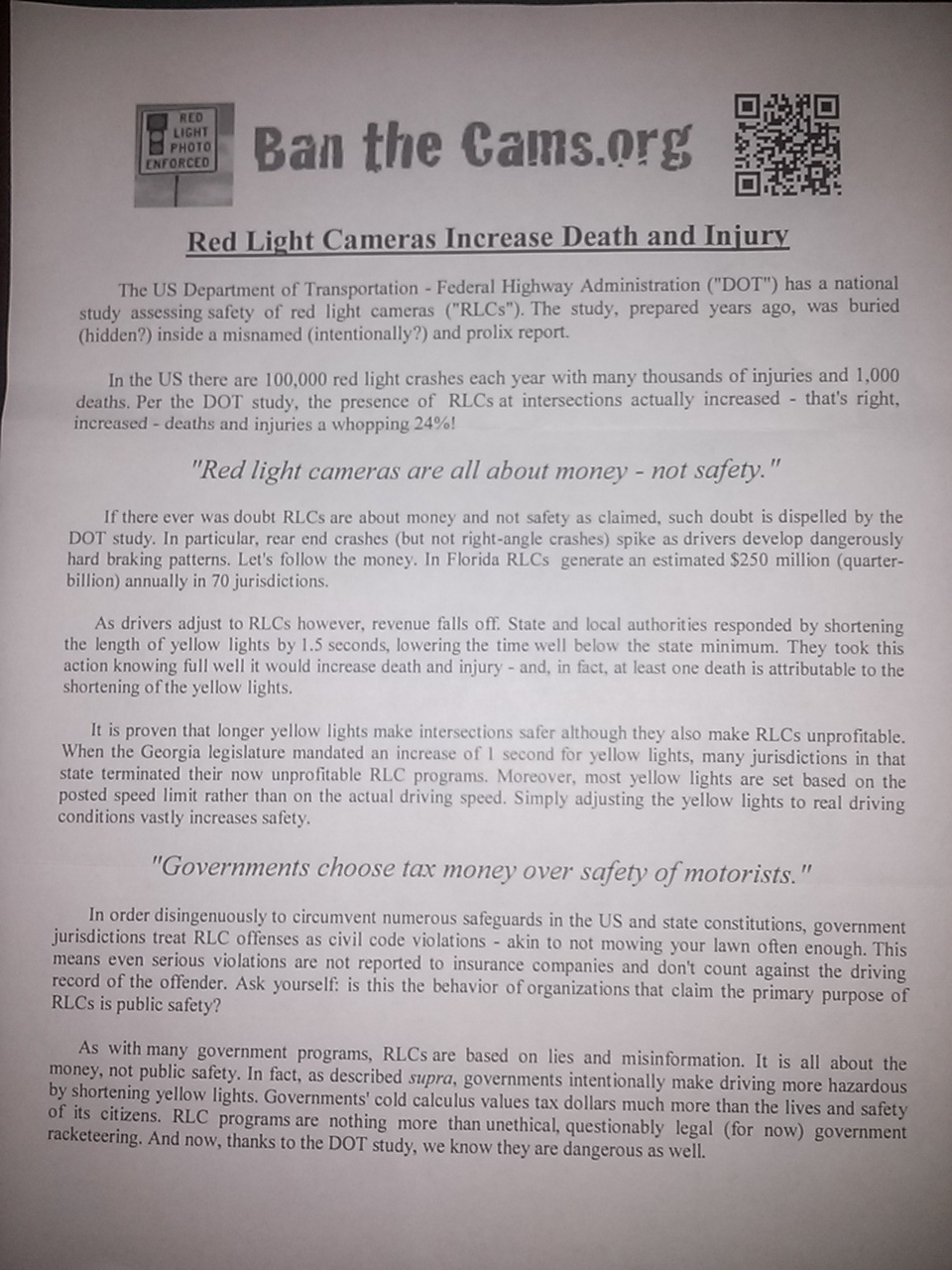
 Police
in Apopka, Florida arrested a man on Saturday morning for distributing a
petition that would put the issue of ending red light camera use to a
public vote. Mark E. Schmidter, a 66-year-old commercial roofing
contractor, stood on the side of the road waiting for the light to turn
red at the corner of East Main Street and South Park Avenue. Once
traffic came to a stop, he would walk in between cars and distribute a
double-sided sheet of paper. One side had a petition form that residents
could fill out and a message urging participation in Wednesday's city
council meeting. The other side provided information on why cameras
should not be used (